

Visual Capitalist: Which States Grew Fastest Since 2021
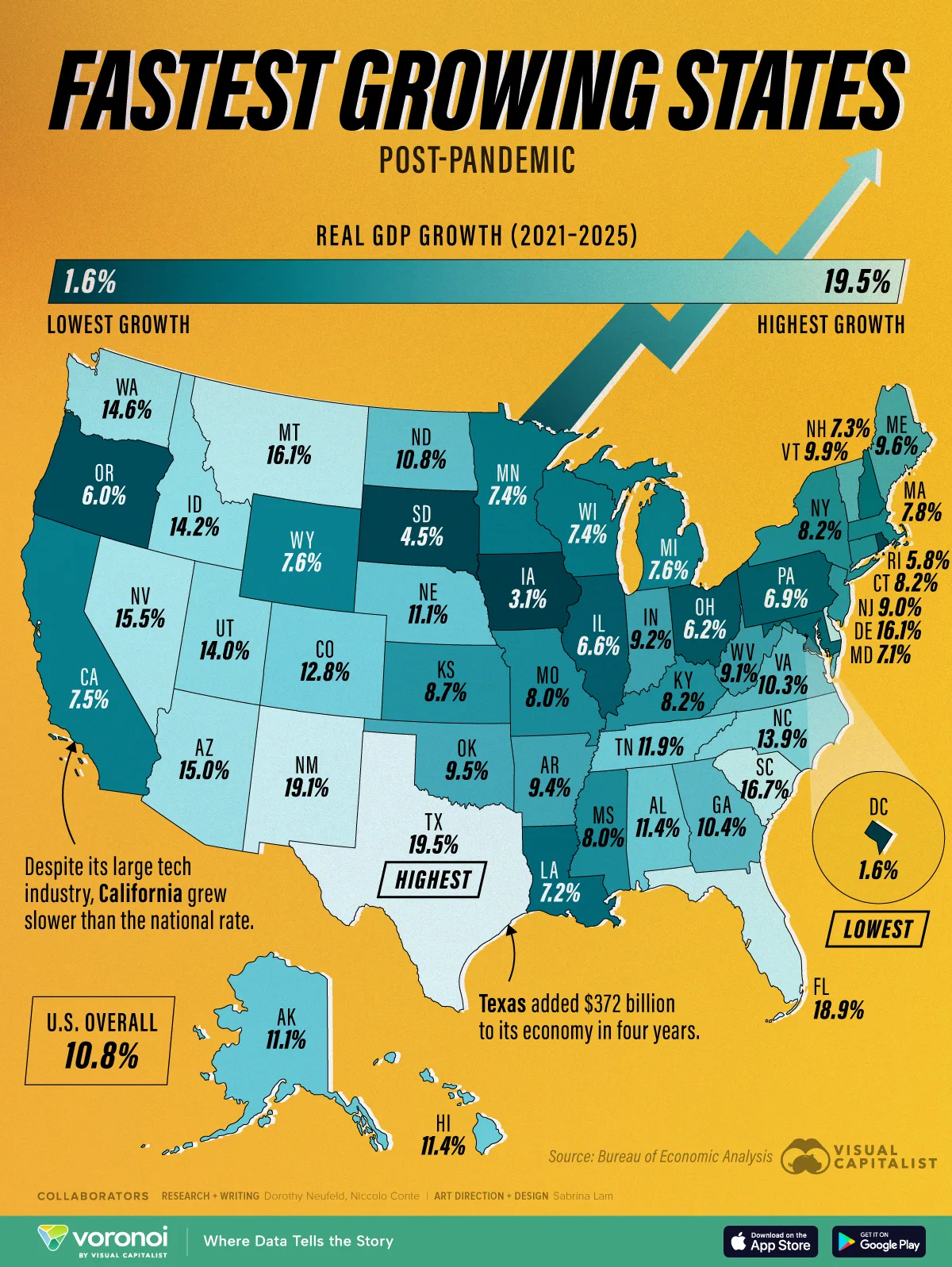
Which States Experienced the Fastest Economic Growth Since 2021?
The years following the pandemic have reshaped the economic landscape across the United States. While some states experienced rapid expansion fueled by population growth, business investment, and energy production, others grew at a much slower pace.
Recent data from the U.S. Bureau of Economic Analysis shows significant differences in real GDP growth among states between 2021 and 2025. These trends reveal where economic momentum has been strongest and highlight the regions attracting new residents, businesses, and investment.
Texas Leads the Nation in Economic Growth
Texas emerged as the fastest-growing state economy during the period, recording nearly 20% real GDP growth between 2021 and 2025.
The state’s economic expansion was driven by a combination of strong population growth, a thriving energy sector, continued business relocation activity, and investment across multiple industries. Texas added millions of residents over the past several years, creating increased demand for housing, healthcare, retail services, transportation, and infrastructure.
Top States by Real GDP Growth (2021–2025)
| Rank | State | Real GDP Growth |
|---|---|---|
| 1 | Texas | 19.5% |
| 2 | New Mexico | 19.1% |
| 3 | Florida | 18.9% |
| 4 | South Carolina | 16.7% |
| 5 | Montana | 16.1% |
| 6 | Delaware | 16.1% |
| 7 | Nevada | 15.5% |
| 8 | Arizona | 15.0% |
| 9 | Washington | 14.6% |
| 10 | Idaho | 14.2% |
| 11 | Utah | 14.0% |
| 12 | North Carolina | 13.9% |
| 13 | Colorado | 12.8% |
| 14 | Tennessee | 11.9% |
| 15 | Alabama | 11.4% |
U.S. Average: 10.8%
The Sun Belt Continues to Gain Momentum
A clear trend emerged from the rankings: many of the fastest-growing states were located in the South and Mountain West.
Florida, Arizona, Nevada, North Carolina, South Carolina, and Utah all posted growth rates well above the national average. These states have benefited from steady population increases, business relocations, and relatively affordable living costs compared to many coastal markets.
As new residents arrive, demand rises for homes, schools, healthcare facilities, retail development, and infrastructure projects. This creates a ripple effect that supports continued economic growth across multiple sectors.
The expansion of remote work opportunities also accelerated migration trends that were already underway before the pandemic. Many workers and employers sought locations with lower operating costs, favorable tax environments, and growing labor pools.
Energy Production Played a Key Role
Several of the highest-performing states also benefited from robust energy industries.
Texas and New Mexico saw strong gains from increased energy production and related investment. As energy demand remained elevated, these states were positioned to capitalize on their natural resources and established infrastructure.
Combined with population growth and business expansion, the energy sector helped fuel economic performance well above the national average.
California’s Growth Was More Modest
One of the more surprising findings is California’s position among the states.
Despite being the nation’s largest economy and home to many of the world’s leading technology and artificial intelligence companies, California’s real GDP grew by just 7.5% during the period—below the national average.
This does not diminish California’s importance as a global innovation hub. Rather, it highlights the reality that larger, more mature economies often experience slower growth rates than states undergoing rapid population and business expansion.
California remains a leader in technology, venture capital, and AI development, but many smaller and faster-growing states have recently posted stronger percentage gains.
States With the Slowest Economic Growth
While many states enjoyed strong economic momentum, others lagged behind.
Several Midwestern and Northeastern states recorded growth below the national average. Iowa, South Dakota, Rhode Island, Oregon, Ohio, and Illinois were among the slower-growing economies during the period.
Washington, D.C. recorded the weakest performance, with real GDP increasing by only 1.6% between 2021 and 2025.
The contrast is significant. Texas grew more than twelve times faster than Washington, D.C., illustrating how uneven economic growth has been across the country.
Looking Ahead
The post-pandemic economy has accelerated shifts that were already taking place across the United States. Population migration, business relocation, energy development, and remote work continue to influence where economic growth occurs.
For now, many Sun Belt and Mountain West states appear well-positioned to maintain their momentum. Whether these trends continue throughout the remainder of the decade will depend on factors such as housing affordability, workforce availability, infrastructure investment, and broader economic conditions.
One thing is clear: the map of economic growth in America continues to evolve, and some states are moving ahead much faster than others.
Read Full Article: https://www.visualcapitalist.com/mapped-states-grew-the-fastest-since-2021-real-gdp/