Risk Managed Strategy Funds

Visual Capitalist: History’s Biggest Companies vs. The Magnificent Seven

August 6, 2025


Key Takeaways

  • Historic companies from the 17th and 18th century were once worth trillions of dollars by today’s standards, thanks to monopolies on trade and speculation.
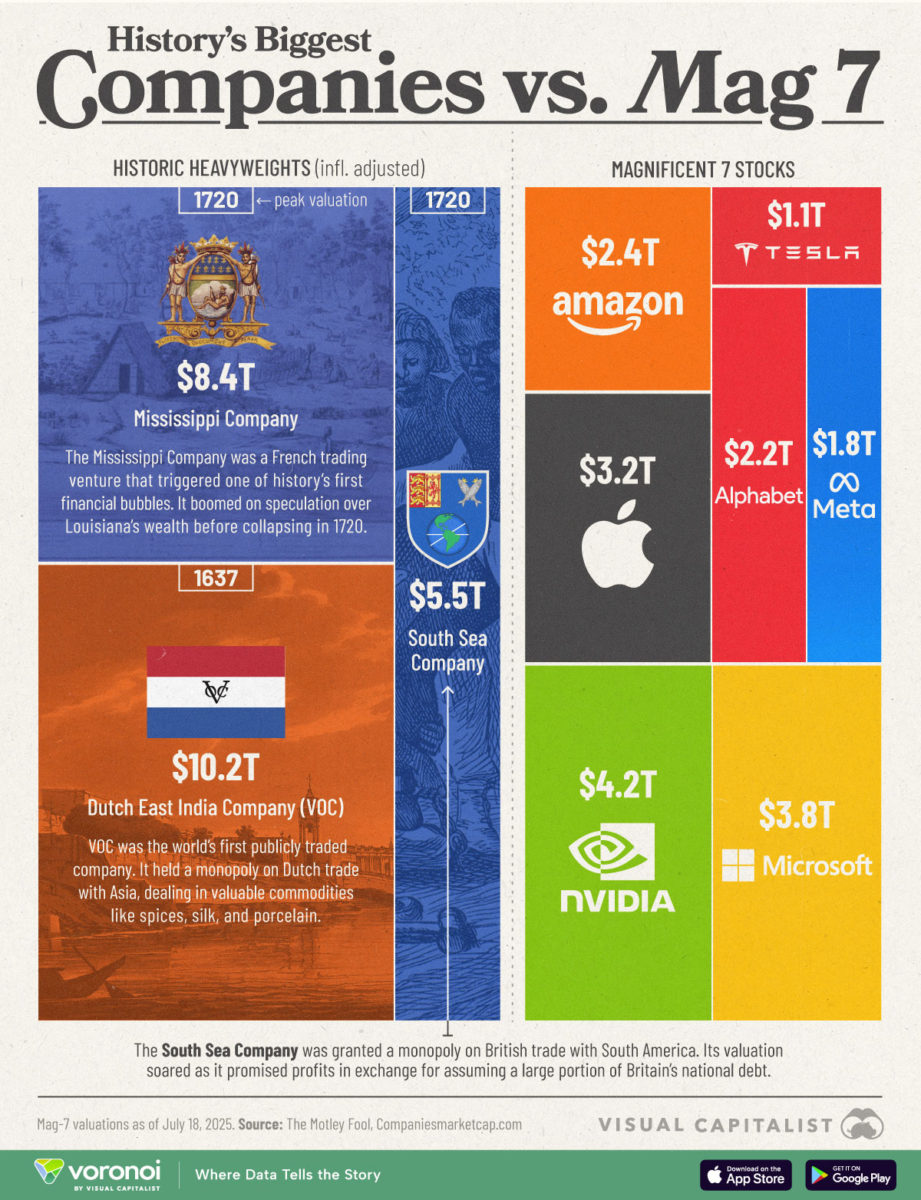
  • This graphic compares the valuation of these companies to today’s Mag-7 heavyweights

The rise of today’s tech giants has redefined market dominance. Companies like Nvidia, Microsoft, and Apple, which form the Magnificent Seven, boast multi-trillion-dollar valuations, but how do they compare to the titans of history?

In this visualization, we compare the market capitalization of Magnificent Seven stocks to three of history’s biggest companies.

Data & Discussion

The data for this visualization originates from a 2012 post by The Motley Fool, which compared peak inflation-adjusted valuations of historical monopolies.

We adjusted these values to current dollars, then compared them to the Magnificent Seven as of July 18, 2025.

CompanyYearValue (USD trillions)
🇳🇱 Dutch East India
Company (VOC)
1637
(peak valuation)
$10.15
🇫🇷 Mississippi Company1720
(peak valuation)
$8.35
🇬🇧 South Sea Company1720
(peak valuation)
$5.52
🇺🇸 NVIDIA2025$4.20
🇺🇸 Microsoft2025$3.79
🇺🇸 Apple2025$3.15
🇺🇸 Amazon2025$2.40
🇺🇸 Alphabet2025$2.25
🇺🇸 Meta2025$1.77
🇺🇸 Tesla2025$1.06


The VOC: Still the Biggest Ever

Founded in 1602, the Dutch East India Company (VOC) peaked at a valuation of over $10 trillion in today’s dollars.

Backed by government charters and global monopolies, the VOC controlled huge parts of the spice trade, giving it unmatched economic power in its time. VOC could acquire exotic goods, establish colonies, create military forces, and even initiate wars around the world.

Despite its 200-year run as Europe’s foremost trading juggernaut – the speculative peak of the company’s prospects coincided with Tulip Mania in Holland in 1637.

Widely considered the world’s first financial bubble, the history of Tulip Mania is a fantastic story in itself. During this frothy time, the Dutch East India Company was worth 78 million Dutch guilders, which translates to a whopping $10.2 trillion in today’s dollars.

Speculative Bubbles of the 18th Century

The other historical companies in this graphic, Mississippi Company and South Sea Company, both peaked in 1720 amid massive speculative bubbles.

At their heights, their valuations hit $8.35 trillion and $5.52 trillion respectively. However, both collapsed shortly after, serving as early examples of market euphoria and financial instability.

For example, the Mississippi Company was a French trading venture with exclusive rights to develop France’s Mississippi/Louisiana territories. Investors were lured by speculation of the vast wealth from Louisiana’s natural resources (e.g. gold), but no profits ever came.

SOURCE: https://www.visualcapitalist.com/historys-biggest-companies-vs-the-magnificent-seven/