

Visual Capitalist: How Government Debt Has Diverged Across Major Economies (2005-2025)
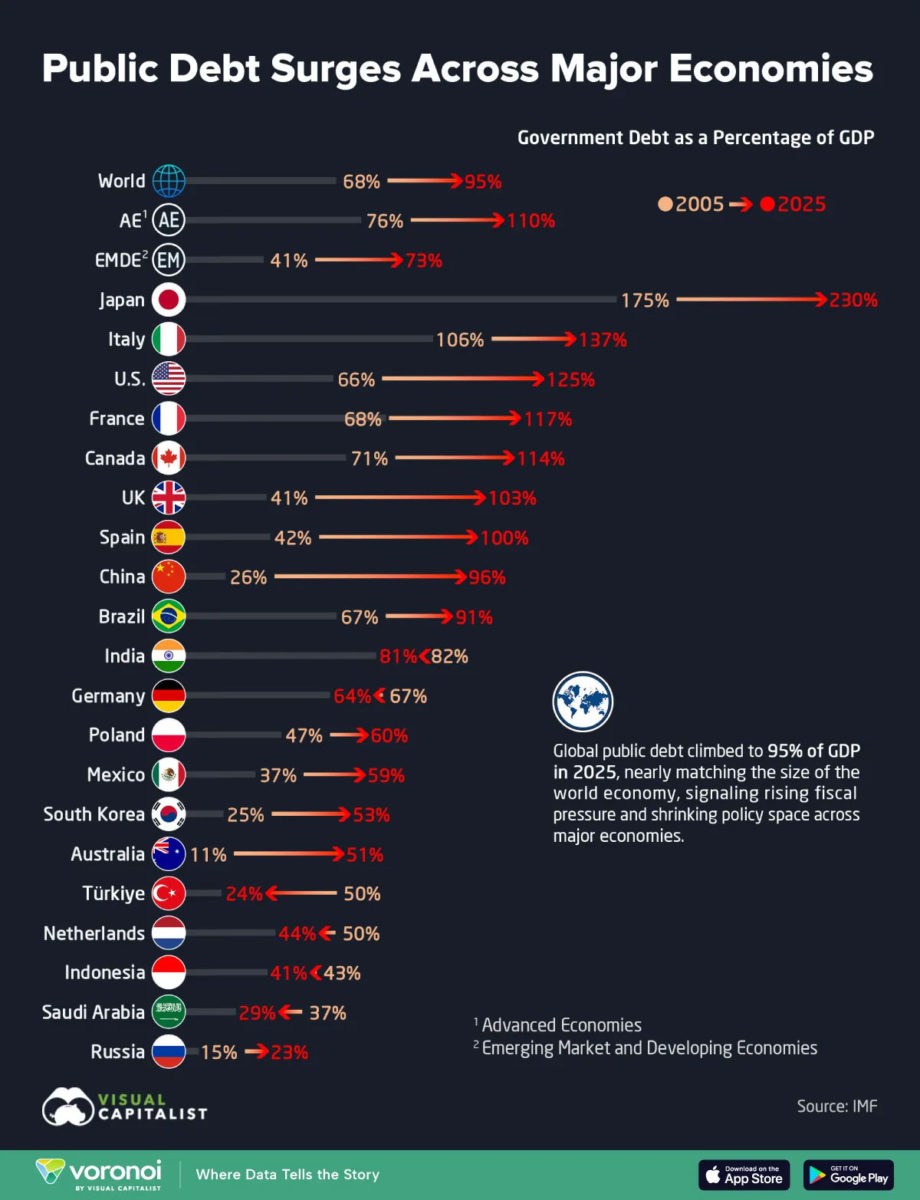
How Government Debt Has Shifted Across Major Economies
Over the past 20 years, government debt levels have moved in dramatically different directions across the world. While some countries have accumulated record levels of debt, others have managed to keep borrowing under control—or even reduce it altogether.
According to data from the International Monetary Fund’s 2025 World Economic Outlook, global government debt climbed from roughly 68% of global GDP in 2005 to approximately 95% in 2025. However, the global average only tells part of the story. Behind the numbers are sharply different fiscal strategies, economic pressures, and long-term policy decisions shaping each country’s financial outlook.
Debt Levels Continue Rising in Advanced Economies
Many advanced economies experienced significant increases in government debt over the last two decades. Rising healthcare and pension costs, economic stimulus spending, and persistent budget deficits have all contributed to higher borrowing levels.
The United States saw its debt-to-GDP ratio rise from 66% in 2005 to roughly 125% in 2025. The United Kingdom more than doubled its debt burden during the same period, while France also moved well above the 100% threshold.
Japan continues to stand apart from other major economies, carrying the highest debt load at approximately 230% of GDP. Despite these elevated levels, Japan has maintained relatively low borrowing costs for years, although global interest rate trends could create future challenges.
Other developed nations—including Canada, Spain, and Australia—also posted notable increases in public debt levels between 2005 and 2025.
Emerging Markets Show Mixed Results
Emerging markets and developing economies also experienced rising debt overall, increasing from around 41% to 73% of GDP during the period.
China recorded one of the largest increases among major economies. Its debt burden climbed sharply from roughly 26% to 96% of GDP, reflecting years of infrastructure spending, economic stimulus measures, and local government borrowing.
Brazil and South Korea also saw meaningful increases, while Mexico and Poland posted more moderate gains.
However, not every emerging economy followed the same path.
Some Countries Reduced Their Debt Burdens
A smaller group of countries managed to lower their debt-to-GDP ratios over the last two decades.
Türkiye reduced its debt ratio significantly, falling from approximately 50% in 2005 to near 24% in 2025. Saudi Arabia also lowered its debt levels, supported in part by strong energy revenues and fiscal reforms.
Germany and the Netherlands also maintained comparatively stable debt positions, highlighting how disciplined fiscal policies can help contain long-term borrowing.
Why These Trends Matter
Government debt plays a major role in shaping economic flexibility. Countries with high debt levels may face greater pressure from rising interest rates, slower economic growth, and increasing borrowing costs.
At the same time, debt itself is not always negative. Governments often borrow to invest in infrastructure, stabilize economies during recessions, or fund social programs. The long-term concern typically centers on whether debt grows faster than the economy itself.
As global economies continue navigating inflation, higher interest rates, and slowing growth, the gap between countries with rising debt burdens and those maintaining fiscal discipline may become increasingly important for investors, policymakers, and businesses alike.
Read Full Article: https://www.visualcapitalist.com/government-debt-diverged-across-major-economies-2005-2025/