

Visual Capitalist: How People Are Actually Using AI At Work In 2026
How AI Is Transforming Workplace Decision-Making in 2026
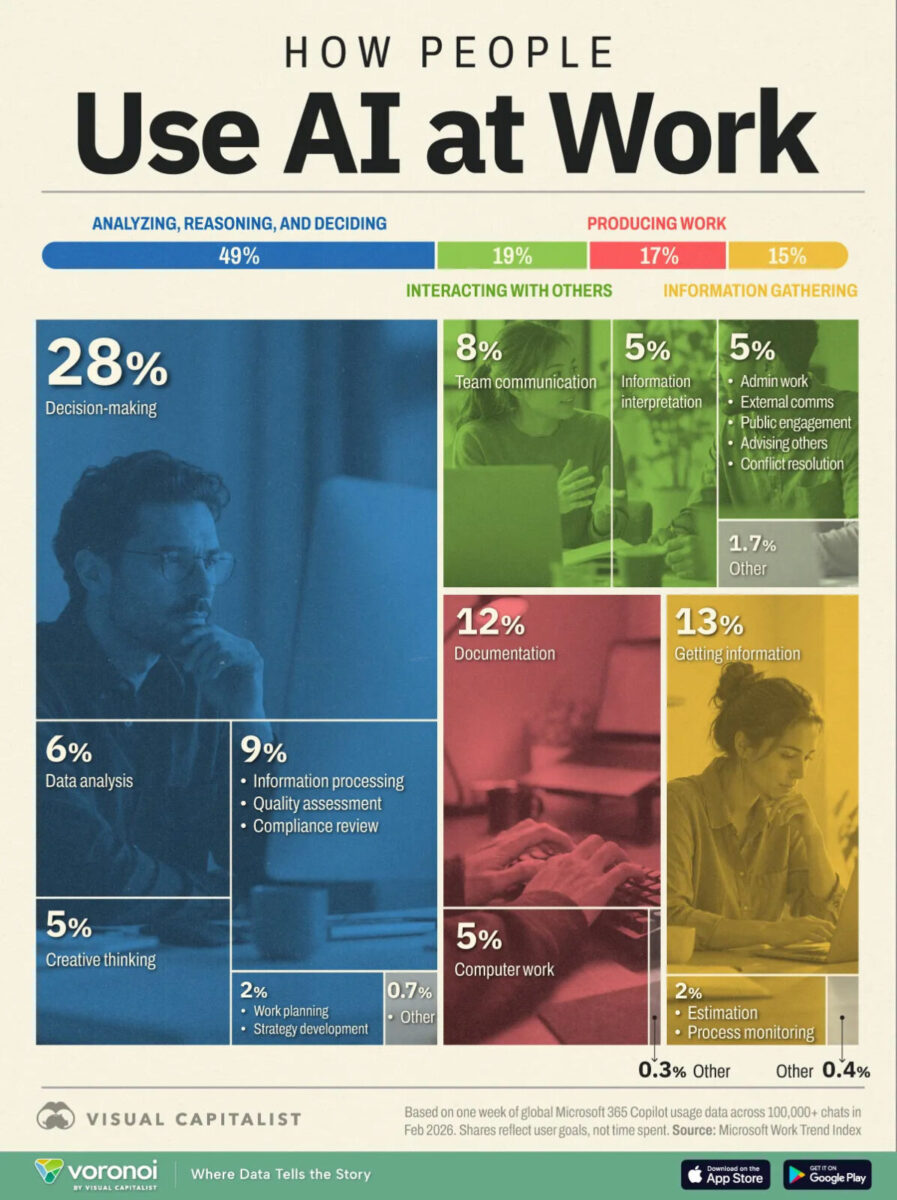
Artificial intelligence continues to reshape how people work, but not always in the ways many expected. While early discussions about AI often focused on automating repetitive tasks, recent workplace trends suggest employees are increasingly turning to AI for something more strategic: helping them make better decisions.
As organizations integrate AI into their daily operations, workers are using these tools to analyze information, evaluate options, and support critical thinking across a wide range of business functions.
AI Is Becoming a Thinking Partner
One of the most notable trends in workplace AI adoption is the growing use of AI for decision support. Employees are leveraging AI to review information, identify patterns, compare alternatives, and generate insights that help guide business decisions.
Rather than simply replacing administrative work, AI is increasingly serving as a tool that enhances human judgment and accelerates problem-solving.
This evolution reflects a broader shift in how organizations view artificial intelligence—not just as an automation solution, but as a resource for improving workplace productivity and decision quality.
Common Ways Employees Use AI
Today’s workforce is applying AI across a variety of tasks, including:
- Decision support and problem-solving
- Data analysis and interpretation
- Research and information gathering
- Creative brainstorming and idea generation
- Document creation and report drafting
- Quality reviews and compliance checks
- Work planning and project organization
- Team communication and collaboration
Many employees now incorporate AI into multiple stages of their workday, making it a routine part of business operations rather than a specialized technology used only by technical teams.
Why Documentation and Research Remain Important
While decision-making has emerged as a leading use case, traditional productivity tasks continue to play a significant role.
Employees frequently rely on AI to summarize meetings, organize notes, draft reports, conduct research, and locate information quickly. These capabilities help reduce the time spent searching for data and allow workers to focus more on higher-value activities.
As AI tools become more integrated into workplace software platforms, documentation and information management are becoming faster and more efficient.
Human Skills Still Matter
Despite rapid advances in AI technology, many workplace activities remain deeply human.
Tasks that depend on relationship-building, leadership, coaching, conflict resolution, and interpersonal communication still require emotional intelligence, empathy, and human judgment. While AI can assist with information and recommendations, people remain essential for managing complex relationships and organizational culture.
This suggests the future workplace will likely combine AI-powered insights with uniquely human skills rather than replacing human expertise altogether.
Looking Ahead
The next phase of workplace AI appears to be less about replacing jobs and more about augmenting how people work. Organizations are discovering that AI can help employees process information faster, evaluate alternatives more effectively, and make informed decisions with greater confidence.
As adoption continues to grow, businesses that successfully combine AI capabilities with human expertise may be better positioned to improve productivity, enhance decision-making, and adapt to an increasingly data-driven environment.
AI is no longer just a tool for automating routine tasks. It is becoming a valuable partner in helping employees think, analyze, and perform at their best.
Read More: https://www.visualcapitalist.com/how-people-are-using-ai-at-work-in-2026/