

Visual Capitalist: The States Driving Americas Economic Growth
Which States Are Leading U.S. Economic Growth?
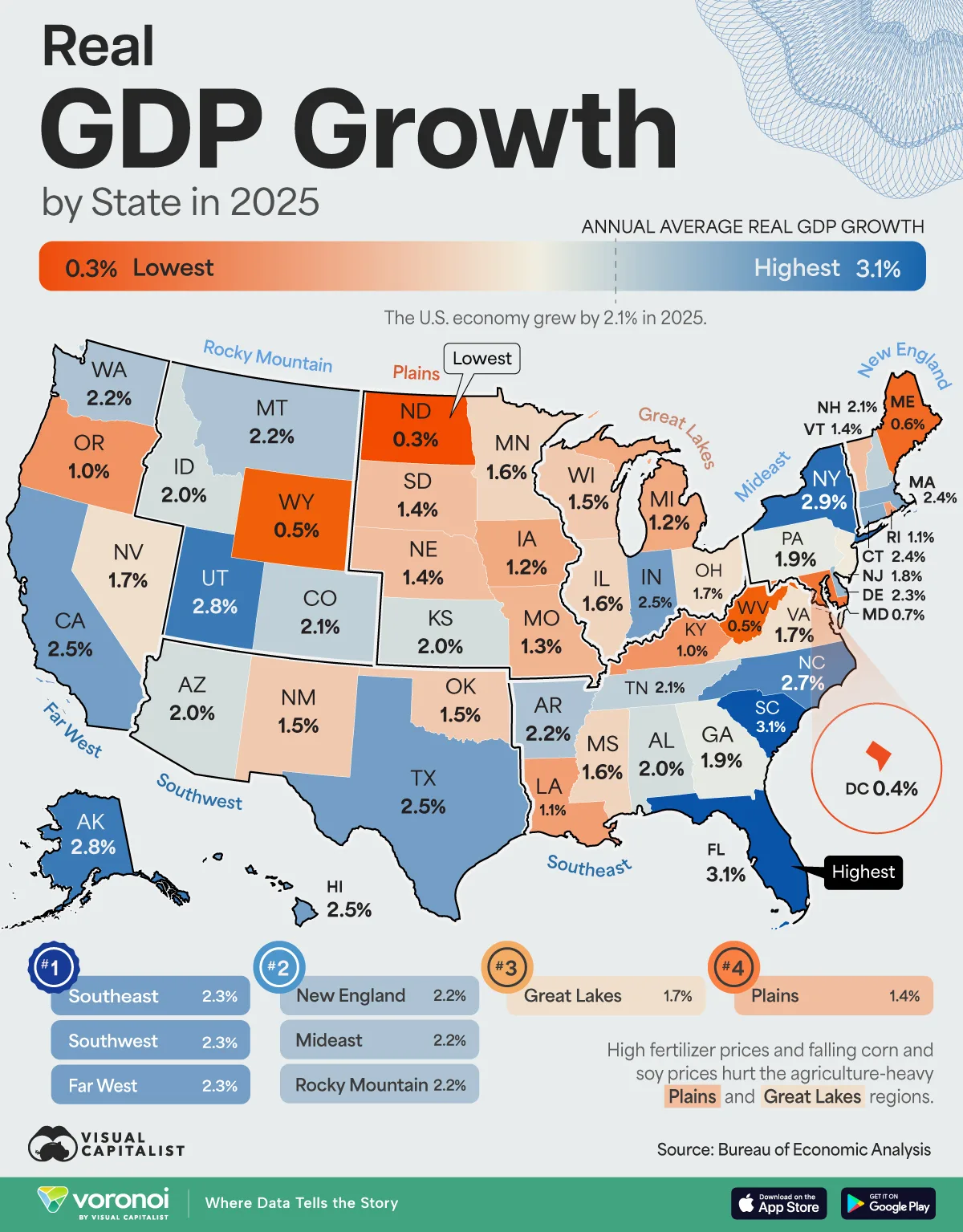
Economic growth across the United States remained positive in 2025, but not all states expanded at the same pace. While the national economy grew by 2.1% after adjusting for inflation, some states significantly outperformed the average, highlighting where business activity, population growth, and investment continue to gain momentum.
Recent data from the U.S. Bureau of Economic Analysis (BEA) shows that every state experienced economic growth during the year, although the rate of expansion varied considerably from region to region.
The Sun Belt Continues to Outperform
Florida and South Carolina led the nation in economic growth, with both states posting 3.1% real GDP growth. Other high-performing states included New York, Alaska, Utah, North Carolina, California, Indiana, Texas, and Hawaii.
Much of the strongest growth occurred throughout the Sun Belt, where lower business costs, competitive tax environments, and continued population migration have helped fuel business investment, consumer spending, and job creation.
States such as Texas, North Carolina, Arkansas, and Florida continue to attract both businesses and new residents, contributing to stronger economic activity than many other parts of the country.
Traditional Economic Powerhouses Remain Strong
Although the South captured much of the attention, larger, established economies also posted impressive gains.
New York ranked among the nation’s fastest-growing economies, while California continued to deliver above-average growth despite ongoing population shifts. Strong performances from technology, healthcare, finance, and professional services helped support expansion in both states.
These results demonstrate that innovation, capital investment, and diversified industries remain important drivers of long-term economic strength.
Some Regions Face Slower Growth
At the other end of the spectrum, North Dakota, West Virginia, Wyoming, and Washington, D.C. recorded the slowest rates of economic expansion.
The Plains and Great Lakes regions generally experienced more modest growth, as several industries—including manufacturing and agriculture—continued to face economic headwinds from changing trade conditions and softer demand.
Importantly, however, no state’s economy contracted during 2025, reflecting broad resilience across the U.S. economy.
What This Means for Investors
Regional economic trends can provide valuable insight into where future opportunities may develop. Population migration, business investment, employment growth, and industry diversification all influence long-term economic performance and can impact investment sectors differently over time.
While economic leadership often shifts from year to year, maintaining a diversified investment strategy remains one of the most effective ways to navigate changing regional and national market conditions.
As always, investors should focus on long-term goals rather than short-term economic headlines.
Read More: https://www.visualcapitalist.com/mapped-states-driving-americas-economic-growth/