

Visual Capitalist: The World’s Riskiest Markets In 2026
Global Investment Risk in 2026: Which Markets Carry the Most Uncertainty?
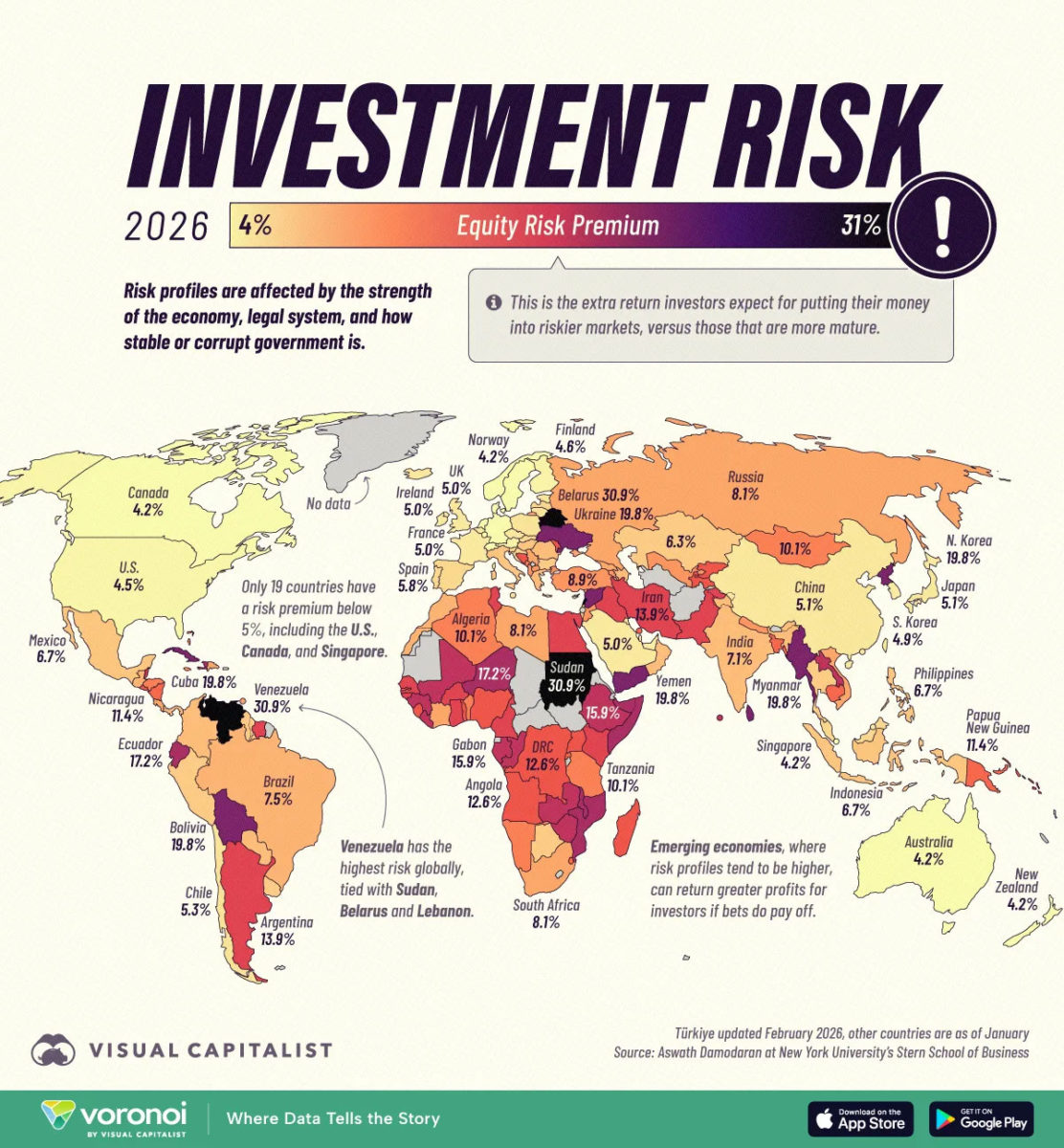
Investing globally can unlock new opportunities—but not all markets carry the same level of risk. In 2026, the gap between stable economies and high-risk regions remains significant, shaping how investors approach international markets.
Understanding Investment Risk Across Countries
One of the key ways investors measure global risk is through something called an equity risk premium—the additional return investors expect when investing in a particular country compared to a stable market.
Higher premiums typically signal greater uncertainty, whether due to political instability, economic challenges, or conflict. Lower premiums suggest more stable, predictable environments.
Where Risk Is Highest in 2026
Some countries currently sit at the top of global risk rankings, with extremely elevated risk levels. Nations experiencing political unrest, economic instability, or ongoing conflict tend to carry the highest premiums.
In today’s landscape, countries such as Belarus, Lebanon, Sudan, and Venezuela are among the most volatile investment environments. These regions face a combination of factors including governance challenges, economic disruption, and geopolitical tensions—all of which contribute to heightened investor caution.
Other nations dealing with instability or conflict—such as parts of Eastern Europe, the Middle East, and emerging markets—also rank higher on the risk spectrum.
Safer Markets and Stability
On the other end of the spectrum are countries known for stable economies, strong institutions, and predictable markets. Nations like Canada, Germany, Switzerland, Singapore, and Sweden continue to be viewed as relatively low-risk environments for investors.
The United States remains among the lower-risk markets globally, though its risk level is slightly elevated compared to some peers. Factors such as market volatility, political dynamics, and economic uncertainty can influence investor perception even in established economies.
Interestingly, only a small number of countries worldwide fall into the lowest risk category—highlighting just how rare true stability can be in global investing.
Why Risk Varies So Widely
The difference in risk between countries often comes down to a few key factors:
- Political stability and governance
- Economic performance and debt levels
- Exposure to conflict or sanctions
- Currency strength and inflation
- Market transparency and regulation
Regions that struggle in these areas tend to demand higher returns from investors—reflecting the additional uncertainty involved.
How Investors Approach Higher-Risk Markets
Not all investors are willing—or able—to take on high-risk opportunities.
Institutional investors, such as pension funds, often prioritize stability due to their long-term obligations. As a result, they may limit direct exposure to volatile markets and instead invest through diversified funds to balance risk.
More aggressive investors may explore emerging markets, but even then, they typically look for signs of improvement—such as economic reform, political stability, or alignment with long-term global trends.
The Bottom Line
Global investing in 2026 is defined by a wide spectrum of risk and opportunity. While higher-risk markets may offer the potential for greater returns, they also come with significant uncertainty.
For investors, understanding these differences—and staying informed on global trends—is essential to making smart, strategic decisions.
Read Full Article: https://www.visualcapitalist.com/mapped-the-worlds-riskiest-markets-in-2026/